
 The Sun has eight planets. Earth is the third planet from the Sun, and Jupiter is the fifth. Jupiter is the biggest planet in our Solar System by far. In fact, it’s over two-and-a-half times bigger than all the other planets combined.
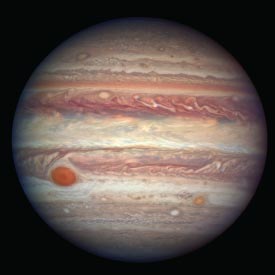
This photograph of Jupiter, which was taken by the Hubble Space Telescope, features the planet’s amazing red spot (on the lower left). The red spot is actually a huge storm that’s been going on for at least 150 years. With winds over 400 miles per hour, it’s a storm that would do great damage to the surface of Jupiter if Jupiter had a surface. But it doesn’t. Jupiter is a huge ball made mostly of gas, so it doesn’t have a hard outer surface.

The Hubble telescope, also picture here, is in orbit about 350 miles above our home planet. Launched in 1990 from the Kennedy Space Center in Florida, the Hubble telescope has helped astronomers learn many new things about the miraculous universe that surrounds us. The Hubble has taken millions of great photos, including many close-ups of our Solar System’s biggest planet.
Fun Fact: The Earth has only one moon, but Jupiter has at least 69 of them, and probably more. Of course, some of those moons are pretty small, but several of them are quite large.
Fun Fact: Jupiter”s largest moon, called Ganymede, is the biggest moon in the Solar System. In fact, Ganymede is larger than the planet Mercury.
Fun Fact: Jupiter is really big! In fact, you could fit 1,300 Earths inside Jupiter, and there would still be a little room to spare.
Fun Fact: If you know when and where to look, you can see Jupiter without using a telescope. In fact, you don’t even need binoculars because Jupiter is one of the brightest objects in the nighttime sky (not counting the Moon, of course!).
Fun Fact: Galileo Galilei, the man who invented the telescope, also discovered Jupiter’s four largest moons. Today, astronomers call them the “Galilean Moons.”