
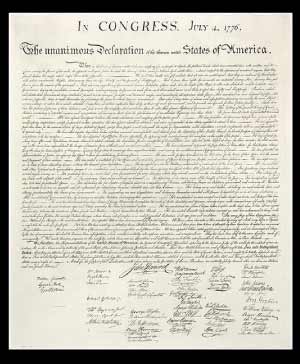
Each year, on the 4th of July, Americans celebrate the signing of The Declaration of Independence. So what, exactly, is it? The Declaration of Independence is a document signed by members of America’s Second Continental Congress. The document stated that the colonies had decided to break away from British rule. They would no longer be a part of the British Empire, and they would fight for their freedom if necessary.
The main author of the Declaration of Independence was Thomas Jefferson. The document was signed (at the bottom) by 56 delegates from 13 British colonies. These colonies became the original 13 states that formed the United States of America.
Today, if you’re celebrating the 4th of July, please remember what the holiday is about. It’s not just about cookouts, and fireworks. It’s also about the freedoms that are summed up in this quote from the Declaration of Independence:
“We hold these truths to be self-evident, that all men are created equal, that they are endowed by their Creator with certain unalienable Rights, that among these are Life, Liberty, and the pursuit of Happiness.”
Fun Fact: The Declaration of Independence was signed by people who represented 13 colonies: New Hampshire, Massachusetts Bay, Rhode Island, Connecticut, New York, New Jersey, Pennsylvania, Maryland, Delaware, Virginia, North Carolina, South Carolina, and Georgia.
Fun Fact: The Declaration of Independence was signed in Philadelphia, Pennsylvania at the Pennsylvania State House, which is now know as Independence Hall.
Fun Fact: Thomas version wrote the original version of the Declaration of Independence. Then, the members of the Continental Congress made a few changes and signed it.
Fun Fact: Jefferson’s original version of the Declaration of Independence, which contains changes made by John Adams and Ben Franklin, is on display at the National Archives in Washington, D. C.
Fun Fact: The Second Congress, which consisted of representatives from the 13 colonies, was the organization that gave final approval to Jefferson’s revised version of the Declaration of Independence.
Fun Fact: The largest signature on the Declaration of Independence is by a prominent patriot named John Hancock. Hancock was the president of the Second Continental Congress, but today he is best remember because of the large, stylish way he signed his name on the Declaration of Independence.
Quotes by Thomas Jefferson
“Honesty is the first chapter in the book of wisdom.”
“I’m a greater believer in luck, and I find the harder I work the more I have of it.”
“Take care of your cents; dollars will take care of themselves.”
“Every day is lost in which we do not learn something useful. Man has no nobler or more valuable possession than time.”
“When angry count to ten before you speak. If very angry, count to one hundred.”
“Delay is preferable to error.”