
 Ben Franklin would have been famous even if he had never invented anything. He was a writer, a publisher, a diplomat, and a Founding Father of the United States of America. But in addition to all those accomplishments, he also invented many useful things, some of which are still widely used today.
Franklin invented bifocal eye glasses (which help people see things close up and far away without having to change glasses), and he invented the lightning rod (which directs electricity from a lightening strike away from a building.
He also invented swim fins (to make you swim faster) and the Franklin Stove, a wood-burning stove that produced more heat and less smoke than a traditional fireplace.
When he served as the first postmaster of the United States, Ben Franklin even invented an odometer that measured the distance that his carriage traveled (That gadget helped him figure out the distance of various postal routes.).
With only two years of formal education, Ben Franklin became one of America’s first great inventors. Maybe someday you’ll become a great inventor, too.
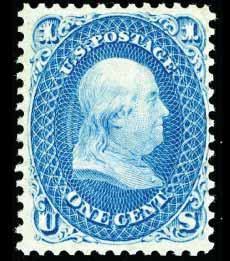
Ben Franklin One-Cent Stamp, Issued in 1861.
Fun Fact: When Ben Franklin arrived in Philadelphia in 1723, he was practically penniless. But over the next two decades he became very wealthy as a print shop owner, a land speculator, and the publisher of the popular Poor Richard’s Almanack.
Fun Fact: Ben was largely self-taught. In fact, he only had two years of formal education. To make up for his lack of time in the classroom, he read lots of books.
Fun Fact: Franklin was the first person to ask Congress to abolish slavery. He did it in 1790, two months before his death.
Fun Fact: Franklin is the only Founding Father to have signed all three documents that freed America from Britain: the Declaration of Independence, the Treaty of Paris, and the United States Constitution. Franklin was the oldest Founding Father to sign the Constitution. He was 81 when he signed it.
Fun Fact: Ben Franklin never patented any of his inventions. He said, “As we enjoy great advantages from the inventions of others, we should be glad of an opportunity to serve others by any invention of ours; and this we should do freely and generously.”